 |
History of East Court, Finchampstead |
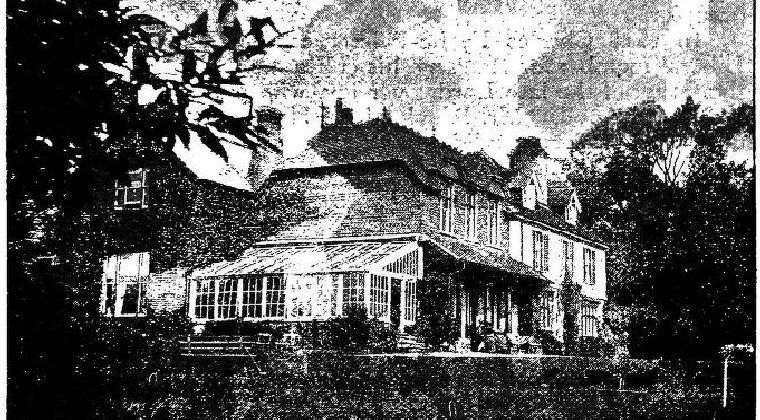
1900 TO THE PRESENT - THE WATSON FAMILY, T.E.LAWRENCE, G.B. SHAW
William Lyon, our esteemed author of the Chronicles of Finchampstead, lived at East Court for several years following the Bentincks. On his departure, East Court and North Court# became home to a very prominent Finchampstead family, the Watsons. This family contained a JP, VC, GCB, two CBs, a CMC, CMG, CIE, MVO. These are just letters to most of us, but to be made a Knight Grand Cross of the Order of the Bath marked the recipient out as a very prominent and influential member of the establishment. Sir John Watson VC, GCB was one of the British Army's most senior commanders, and was appointed an Aide de Camp to Her Majesty The Empress Victoria.
The Watson Family burial plot in St James Churchyard, Finchampstead. This commemorates General Sir John Watson VC, GCB, his two sons Major Generals William and Sir Harry Watson, George Watson JP and their wives. |
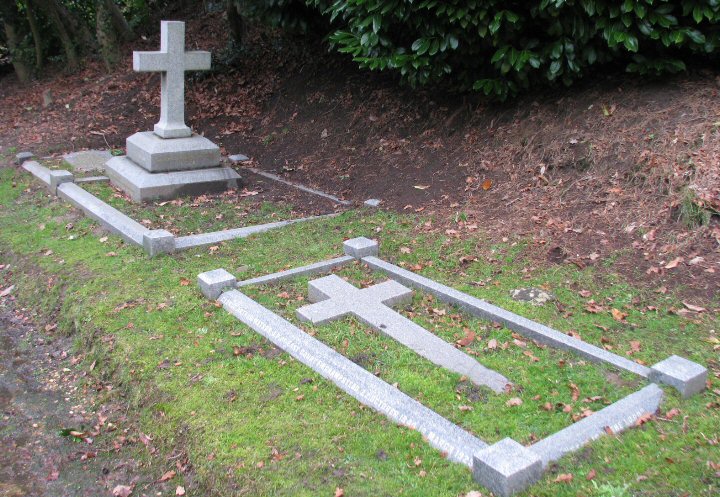
From the PCC records: the following members of the Watson family are all commemorated under attractive grey marble tombs in St James' Churchyard -
General Sir John Watson, V.C., G.C.B (VC won in the Indian Mutiny). His personal banner, formerly hung in the Henry Vll Chapel in Westminster Abbey, before being brought back to Finchampstead church to be close to his home.
George Arthur Watson JP of East Court Finchampstead, born 22nd October 1844 and died 18th March 1929 age 84 years. Phillipa Harriet Watson born 20th January 1846 and died 1st October 1936 age 90 years.
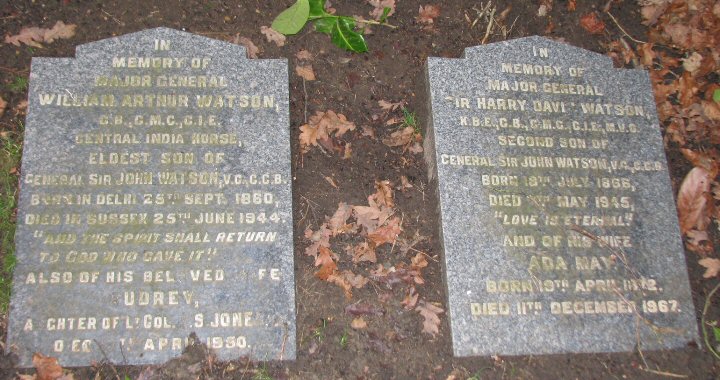
Major General William Arthur Watson CB CMG CIE Central India Horse and eldest son of Sir John Watson, was born born in Delhi on 25th September 1860 and died in Sussex on the 25th June 1944. Army. Plot S11. He served with distinction in North Africa during WW1. See the attached pdf for more about his desert warfare role, which is interesting when viewed alongside that of TE Lawrence in Arabia (see below).
Major General Sir Harry Watson KBE CB CMC CIE MVO, 2nd son of General Sir John Watson VC GCB, was born 18th July 1866 and died 7th May 1945 age 78 years.
VICTORIA CROSS CITATION: JOHN WATSON
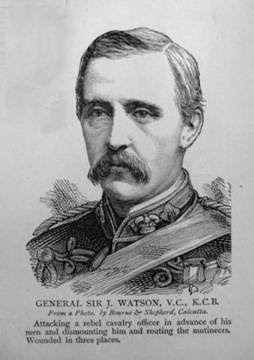
(Lieutenant, now General, G.C.B.) 1st Punjab Cavalry. On November 14th 1857, Lieutenant Watson, with his own squadron, came across a body of the enemy’s cavalry. The Ressaldar in command rode out at once to the front, and was singled out by him. As they approached one another the rebel fired at him at only a yard’s distance, but without effect. (The bullet, it is believed, had previously fallen out. In those days the pistols were muzzleloaders.) A hand-to-hand struggle took place, and the Ressaldar, run through the body by Lieutenant Watson, was dismounted, but nothing daunted, drew his tulwar, and with the help of his men, returned to the attack. Our cavalry just then coming up, the enemy were routed, losing a number killed. Lieutenant Watson had received a blow on the head from a tulwar, another on the left arm, severing the chain gauntlet-glove, another on the right arm, dividing the sleeve of his jacket, and a blow on the leg, which lamed him for some days. He also received a bullet through his coat. Sir John Watson was born in 1829, entering the Bombay Army 1848. Served in the Punjab 1848-9; Bozdar 1857; through the Mutiny as above; and the Afghan War 1879-80. From 1881 to 1888 was Governor General’s Agent at Baroda.
An interesting footnote to the Watson Dynasty. Finchampstead has another VC hero, Lt Colonel Alfred Jones, VC (1832-1920). He also won his VC during service in India, and on his retirement from active service, became the manager of the Army Corps Sewage Works in Aldershot. His daughter, Marguerite Audrey Jones, married Major General William Arthur Watson (mentioned above). So the daughter of a Finchampstead VC winner married the eldest son of a Finchampstead VC winner. They are commemorated in the gravestone in Finchampstead Chuchyard.
The graves of Major General William Watson and Major General Harry Watson in Finchampstead Churchyard. Notice that this is also the final resting place of William's wife Audrey Watson, nee Jones, whose father was also a Finchampstead Hero and VC holder.
|
RECOLLECTIONS OF THE WATSON FAMILY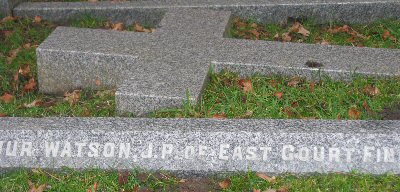
I (Philip Grayson) spoke with Margaret Mearing in Nov 2009 when she was selling poppies. Nearly 90, she remembered East Court running as a dairy farm in the 1920s. She used to call in on the way to school and leave a metal jug on the window sill of the current snooker room (which at that time was the estate kitchen). At the end of the day she'd collect a jug of skimmed milk left over from the cream/butter making. Sometimes it would be a whole jug, sometimes less, but always just one penny.
The lady of the house was Lady Phillipa Watson, described by Margaret as a splendid lady, well known locally, and much mourned when she died - most of the village turned out for her funeral.
[#North Court has never possessed any manorial rights of its own ; the properties of which it is now composed originally formed part of the Manor of East Court, and the name of 'North Court' was only adopted when the present house was built by the late Rev. T. Moseley, about the year 1860 [subsequently destroyed in a fire in August 1997 and rebuilt as a shadow of its former glory as flats]. The only houses in Finchampstead which are strictly entitled to the appellation of ' Court ' are the chief residences of the ancient east and west moieties of the Manor of Finchampstead, viz. 'East Court' and 'West Court'.*]
WALTER FAMILY SELLS FINCHAMPSTEAD, INCLUDING EAST COURT, TO SUPPORT 'THE TIMES'
"Finchampstead Past Present and Future" tells us that John Walter II was a very beneficent patron to Finchampstead. He built the village school in 1854 and later, in 1861, he constructed the road across The Ridges to Crowthorne, lining Wellingtonia Avenue with Sequoia trees brought specially from 'New Columbia' as a memorial to the Duke of Wellington. At that time, the avenue was more noticeably a magificent approach to the gates of Wellington College, which is now less obvious because of the building development around Crowthorne station.
The 3rd John Walter was editor of The Times when the newspaper was fighting competition from the newly launched penny papers on Fleet Street around 1900, namely the Daily Mail and the Daily Telegraph. The Times had been fivepence for 100 years. Walter dropped the price to three pence, and was forced to seek funds to support this competitive strategy. In 1911, he chose to sell his Bearwood Estate, including most of Finchampstead. As a result, East Court passed to new owners, the Watsons, and Finchampstead Ridges was acquired by the National Trust (substantially funded by the generosity of John Walter III who agreed to match-fund monies raised by local residents to acquire The Ridges to prevent development activity).
THE STORY OF EAST COURT, T.E. LAWRENCE AND GEORGE BERNARD SHAW
In her old age, Lady Phillipa relinquished East Court, and it was occupied (early 1930s) by a former pilot. The story is that in his flying days, this pilot had just flown an amphibious aircraft a record-breaking distance (believed from Calcutta) and running out of fuel, crashed on trying to land in the waters of the Solent. 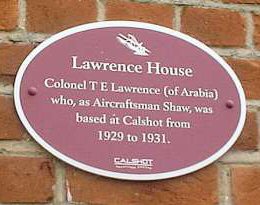
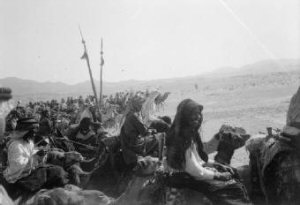
A certain Aircraftsman Shaw had been working at Calshot Base on the development of high-speed rescue launches for the RAF. Seeing the crash, he took the RAF's antiquated launch out and rescued three, but not all of the crew. This experience had a profound effect on Shaw, who used the experience to press (successfully) for the RAF to devote resources to developing better rescue craft.^
Taking a step back in time, the young Shaw had applied to join the RAF in 1922, and was interviewed by a certain Capt WE Johns (himself a WW1 war-flier hero, and author of the famous 'Biggles' books). Judging that Shaw was not telling the truth about his name and background, Capt Johns refused Shaw's application, but he was over-ruled by 'Those On High' who knew the truth behind the pseudonym Shaw.
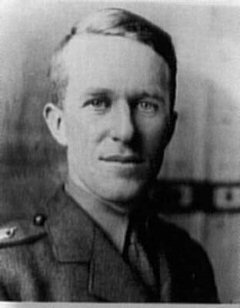 It was the legendary TE Lawrence (of Arabia) who had tired of the endless pressures of fame, and changed his name to Shaw in honour of his friend and mentor George Bernard Shaw. Thus, as Aircraftsman Shaw, he served the RAF, and as a result of the sea-rescue, became a friend of the man who on leaving the RAF, lived at East Court. Shaw/Lawrence and his friend and literary sparring partner GBS became regular visitors to East Court in the 1930s, Lawrence on his Brough Superior motorbike (on which he was to die in 1935).
^Extract from T E Lawrence studies
'Through owning this speedboat, both Lawrence and his CO became interested in replacing the slow conventional boats used as seaplane tenders with something faster. In February 1931 Lawrence watched as an R.A.F. flying boat crashed while landing a few hundred yards offshore. He rushed to the duty boat but by the time they reached the scene several of the aircraft's crew had drowned. He later gave evidence at the Inquest, and helped his CO campaign within the RAF for faster boats. The immediate result was his posting to Hythe, where Hubert Scott-Paine had begun building hard chine planing hulls at the British Power Boat Company.'
GEORGE BERNARD SHAW
‘George Bernard Shaw also enjoyed a (somewhat stormy) friendship with T.E. Lawrence, known most notably for his book Seven Pillars of Wisdom and his role as liaison for the Arab revolt during World War I. Lawrence even used the name "Shaw" as his nom de guerre when he joined the Royal Air Force as an aircraftman in the 1920s.’ GBS helped Lawrence edit the book, aiding him especially with grammatical errors. In the preface to Seven Pillars, Lawrence offered his "...thanks to Mr. and Mrs. Bernard Shaw for countless suggestions of great value and diversity: and for all the present semicolons." 'Seven Pillars' was published in 1926, and to avoid the immediate publicity, Lawrence served in India 1926-8.
THE LATER YEARS
The property was occupied for around 30 years by two increasingly elderly female companions, the widow of Group Captain Hamilton-Ely, and a friend - the Misses Spence and Hamilton-Ely. At some time during that period, the large property became too much for them to manage, and a large portion was sealed off, including the master bedroom and top floor. The stables and coach house were left to deteriorate, and the property suffered from a long and slow decline.
During the 2nd World War, the cellar was extended to reach the front door: this enabled the cellar to be used as a bomb shelter, and meant that breaking out by the front door would have been possible had the cellar entrance been blocked by damage from above. (Bomb damage was not unknown even in this rural setting: the Master of Wellington College was killed at his college residence by a German bomb.)
Eventually the two elderly ladies went into residential care, and in 1987 East Court was acquired by Alex and Jean Glover, the owners of Terranova Crane Hire. Mr Glover reopened the unoccupied parts of the property, including breaking through to the top floor, and discovering the original staircase up in the loft. He restored this to its former glory and reinstated the master bedroom. he also undertook a major restoration of the many roof faces, leadwork, and rooflight windows.
In 1991 Terranova failed, and Mr Glover was made bankrupt. Just prior to this, the last portion of agricultural land (about 15 acres) disappeared from the title to East Court, leaving it with its current plot of approximately 2 acres. Legal wrangles involving the mortgagee and trustee in bankruptcy meant the property remained unsold, unoccupied, damp and unloved for about 2 years.
In 1993 the property was acquired by Philip and Janice Grayson, who have continued the renovation work. The derelict Coach House and stables were rescued and sympathetically restored to use as a large self-contained annexe. More details of the programme of renovation works can be seen here.