 |
History of East Court, Finchampstead |
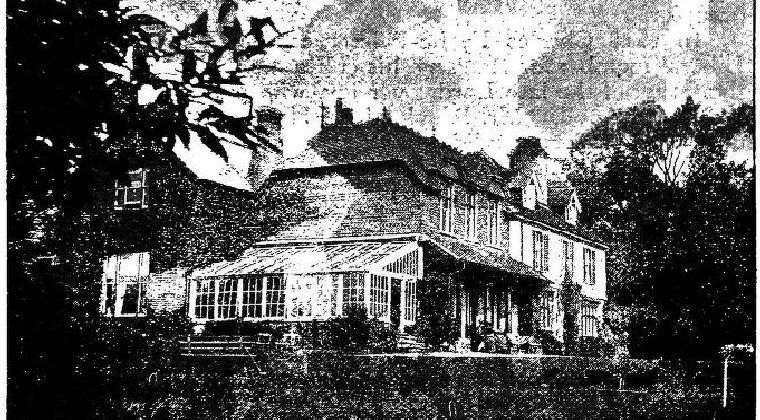
EAST COURT - THE EARLY YEARS
1086: The Domesday Book mentions a Roman wall that runs through the East Court Manor.
1120 John Bannister (Banastre) of the Banastre Family, one of the oldest noble families of Berkshire, was Lord of the Manor of Finchampstead. 'After a long and careful research I have ascertained that the ancient residence of the lords of the whole Manor of Finchampstead was on the hill adjoining the church ; and I think there can be no reasonable doubt that the church was built by one of these lords — possibly by Earl Harold in the eleventh century, or by Alard Banastre in the twelfth century.'*
1298 Finchampstead divided into East Court and West Court: East Court (as the original manor house by Finchampstead Church) was inherited from Sir William Banastre by his eldest daughter, Constance Banastre who married John De La Hoese.
Extract from the Parish Council Website’s history page:
“From the late 13th century, the parish contained two manors since the lands of the lord of the manor, William Banister, became divided between his two daughters. Constance took East Court, near the church, of which only a 17th century wall remains, and Agatha had West Court. East Court later passed into the hands of the Foxleys of Foxley Court (Bray) and Bramshill Castle (Hampshire). They were bigwigs at the Royal Court in Windsor and have fine brass memorials in Bray Church. Their descendants sold up to the Pakenhams and it was probably Sir Edmund Pakenham's two daughters, Constance and Elizabeth, who are the subject of an old story about East Court. It is said that King Henry VIII was a frequent visitor to the manor since he had amorous designs on a daughter of the house. Her elder sister, however, was madly in love with the King herself and, in a fit of jealous rage, threw herself off the balcony in front of him in order to prevent her rival becoming Queen of England.”
Henry Hinde, Lord of the Manor of East Court Finchampstead, was purveyor to the royal stables in the reigns of Henry VIII, Edward VI, Mary and Elizabeth. According to his epitaph, "he for his true zeale in religion, his faythvell service to his Prince and country, and his harty love for his neighbours, was as a perfecte merror for his ensuiinge posteritie to imitate, who departed this life xxviii daye of December, 1580".
 c.1590 the old Manor House by the church was dismantled and the manor of East Court moved to the existing site.
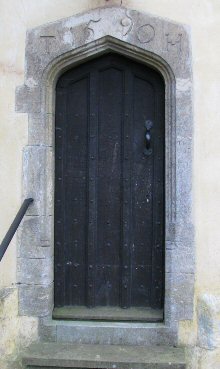
1590 Thomas Harrison Esquire of East Court carried out development work at the Church, including a new entrance known as “The 1590 Door” (which carries his initials and date on the outside lintel). It is thought that this work was connected with the demolition of the old manor house and move of the Manorial home to the present site.
Extract from Chronicles of Finchampstead:
“There is (chap.5 AD1623, p139) always very great difficulty in identifying old houses which have changed their names, and ' Cowdries ' and 'East House' have been a great puzzle to me for a very long time ; but I have at last been able to recognise them, respectively, as the ancestors of the present East Court House, and of what is now known as the ' Manor Farm,' close to East Court House.
In the first place, it will be observed that East House in 1623 had formed part of the West Court Manor, and appears to have been held by John Bligh from the owner of that Manor subject to an annual quit-rent. In 1630 East House 1630 appears to have been transferred to the East Court Manor, and had passed into the possession of Nicholas Taylor, the father of John Taylor.”
Known in 1602 and 1607 by the name of 'Cowdries’, and was then in the occupation of John Taylor, according to the East Court Manor Rolls. John Taylor appears to have held this house and its lands for some years previously to 1602; and the old woodwork of the staircase, and the panelling which still exists, would seem to indicate that the oldest part of the present house belonged to the sixteenth century.
'In 1615 ‘Cowdries' had passed into the possession of ‘Mr Marsh’, who was no doubt the second husband of Elizabeth, widow of Richard Harrison, the son of Thomas Harrison, Lord of the East Court Manor.”*
SIR RICHARD HARRISON (1583-1655)
1613 Richard Harrison, owner of East Court, in boundary dispute with West Court over ownership of the New Mill Eversley and attached lands. He had inherited the estates of Hurst and East Court at Finchampstead from a grand uncle Richard Warde (the son of Richard Warde Senior, MP). He was knighted on 31 August 1621.
In 1621 Harrison was elected Member of Parliament (MP) for Wootton Bassett. He was elected MP for Berkshire in 1624 and again in 1628 and sat until 1629 when King Charles decided to rule without parliament for eleven years. He is said to have been created a baronet but the patent was lost. He was High Sheriff of Berkshire in 1636.
In April 1640, Harrison was elected MP for Windsor in the Short Parliament. In the civil war, his son Richard fought on the Royalist side and the family suffered in the royal cause.
PALMER FAMILY
East Court came into the possession of the Palmer family when Richard Palmer (1611-1670) of Wokingham purchased the manor (in 1661). He is buried in the north aisle of Finchampstead Church under a black marble slab. His son and heir, also Richard Palmer, and no children, and was succeeded by his brother, Charles Palmer MD. Under his will, some of the land was sold, but was repurchased by his cousin, Humphrey Fish of Ickwell, to whose son Henry the manor was devised on condition that he assume the surname of Palmer as well as Fish. Thus Henry Fish, or Fyshe, became Henry Fyshe-Palmer, who was succeeded by his son Charles Fyshe-Palmer (see below).
1662 Hearth Tax – East Court was assessed at 8 hearths. (West Court was assessed at 7 hearths).
'I am unable to state with certainty where Mr. Charles Fyshe-Palmer resided immediately on his succeeding to his Luckley and Finchampstead property, but most probably it was at Luckley, as there was no house at that time quite suitable for him on his East Court estate. The old Manor House on Church Hill had not been occupied by its owner since Richard Palmer's death in 1670 ; and as it had since been used as a farmhouse for 137 years, it had most probably fallen out of repair, and would have required great alterations to adapt it to the modern requirements of a large landowner.
Mr. Fyshe-Palmer therefore appears to have decided upon adopting another house upon his estate as his future residence, and the house now known as ' East Court ' was the one which he selected.
The earliest mention of this house which I have met with is in the East Court Manor Roll of 1602, and in Nos. 80, another Court Roll of 1607, where it appears under the name of 'Cowdries', and in the occupation of John Tailor, 'who paid ten shillings a year for it'.
These small annual rents are no indication of the real value of the property which they represent. Freehold and leasehold properties on a manor were acquired by purchase, subject to a small annual payment to the lord of the manor in acknowledgment of his manorial rights. John Taylor appears to have held this property of Cowdries by leasehold for some years previously to 1602.'*
CHARLES FYSHE-PALMER, MP (1769-1843)
Charles Fyshe-Palmer was elected MP for Reading in 1818. He married Lady Madelina, second daughter of the 4th Duke of Gordon (1743-1827). The Duke of Gordon raised (ie founded) the famous Gordon Highlander Regiment. Lady Madelina and her mother (Lady Jane) were acknowledged beauties and played a key role in the recruitment. After the first pass for recruits had found only 11 volunteers, they volunteered to act as recruiting sergeants, and after a false start, they placed a guinea between their lips, challenging the men to remove the guineas with their own lips. Many accepted the challenge, thus bringing into existence the Gordon Highlanders.
'In 1826 came perhaps the severest electioneering contest that Reading has ever known. After six days' polling Monck had polled 580, Spence 492, Palmer 488, Wakefield 366. A scrutiny ensued, which resulted, in March 1827, in Palmer being declared to have polled 481, while Spence had only polled 458. Monck and Palmer were therefore returned as duly elected. This election is said to have cost, together with the scrutiny, about 20,000/. There were great rejoicings in Reading on the occasion.'* [It is notable how small the electorate was, because so few people were entitled to vote: an issue that was later to occupy the editorial minds of the Walter family atThe Times.]
Mr. Palmer appears to have been very fond of his East Court Manor, and carefully preserved all the fine timber on the estate. He was the first owner who began to plant the Scotch fir trees upon the wild heath lands and commons of the Manor, a practice which was extensively followed by his successor, the late Mr. John Walter. He died in January 1842. Lady Madelina Fyshe-Palmer died in 1847 ; they were both buried at Finchampstead. Sir John Gordon Sinclair, the son of Lady Madelina by her first marriage, succeeded to the East Court property, and sold it on November 7, 1849, to Mr. John Walter, of Bearwood, who thus became its twenty-seventh possessor since the division of the Manor in the thirteenth century.